Latest article · Perspective
The Discipline You See. The Purpose You Don't.
What if discipline isn't something you have, but something you build?
Download PDF ↓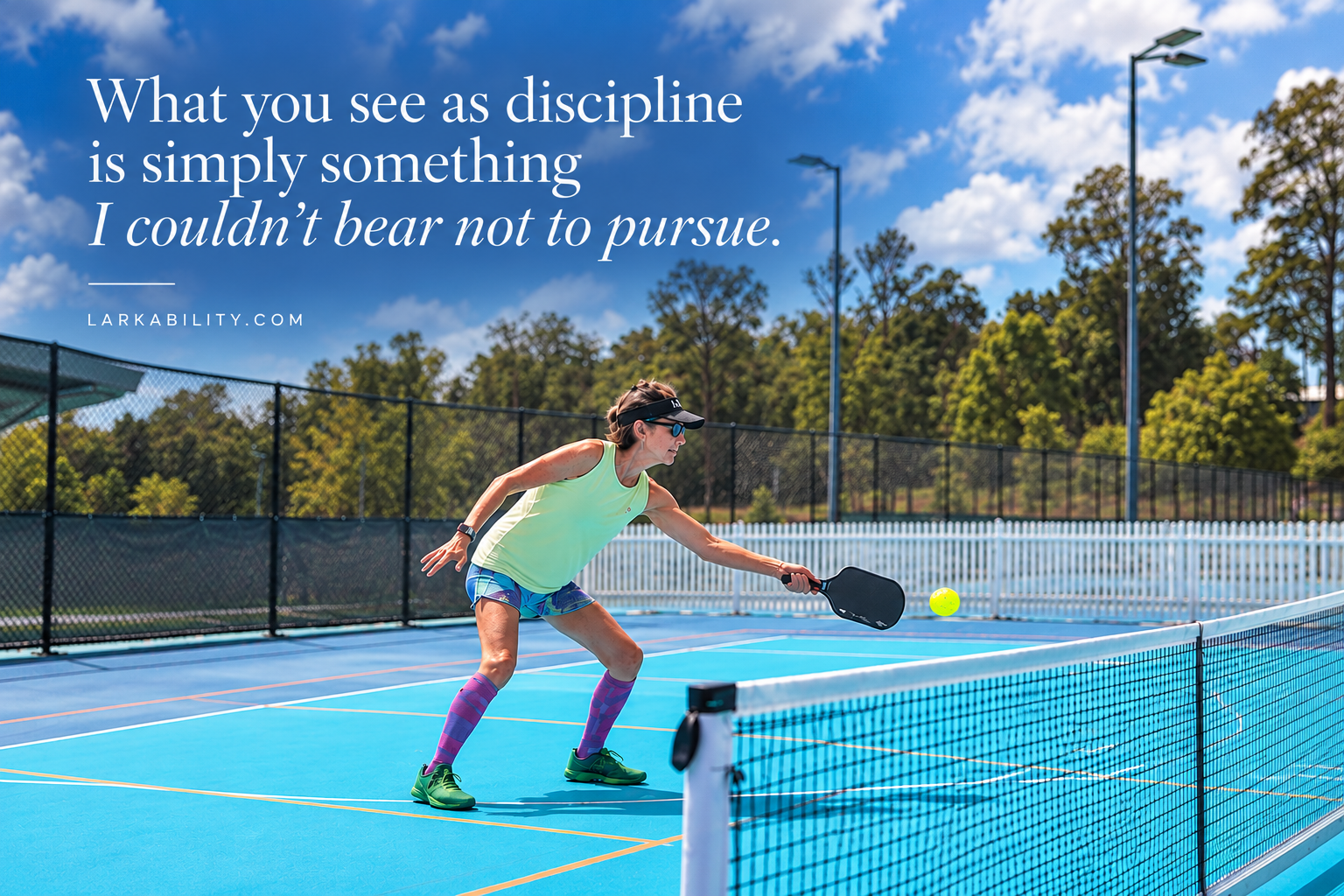
“Oh, but you're so disciplined. I could never do what you do.”
I've heard variations of that statement many times over the years. And, if I’m being truthful, it has always irritated me a little. Not because I don't appreciate the compliment. I understand what people mean. They see me going to the gym, eating in a particular way, training for pickleball, or working consistently towards a goal. They see commitment. They see results. And they call it discipline. But there's something about that word, or perhaps the way we use it, that has never sat comfortably with me.
It makes discipline sound like a personality trait. Something you're born with. Something some lucky people possess and others simply don't. Oh, you're disciplined. I'm not. End of story. But I don't believe that's how it works. And recently, I've been thinking about what discipline actually means to me, where mine came from, and whether we've been asking the wrong question all along.
What you see isn't necessarily what I experience
Here's a thought that captures something I've struggled to explain for years: “What you call my discipline is simply something I couldn't bear not to pursue.”
That sentence gave me a lump in my throat when I wrote it. Because when I look back over my life, I can recognise a pattern. There have been moments when something has caught my attention so powerfully that I've felt almost compelled to follow it. Not because I knew exactly how it would turn out. Not because I had a detailed plan. But because something about it mattered to me.
I remember seeing myself using sign language fluently, long before I became a professional interpreter.
I remember discovering the art of chocolate making and imagining myself creating beautiful sweets after receiving a gift of exquisite Belgian chocolates. Years later, I ran my own chocolate business for over a decade.
And I remember my first experience of pickleball. One hit. The first thwack of the ball against the paddle, and something had me hooked. Later, I saw a post about a woman in her nineties playing competitive pickleball, and something inside me said, Yep. That's me! That's what I’m gonna be doing in my 90s!
I don't mean that I can predict the future. I mean that I recognise a possibility I want to pursue, and once something gets its hooks into me, I have a tendency to keep chipping away at it. Sometimes for decades.
The hook comes before the discipline
I've realised that, for me, discipline often begins with a choice.
We all encounter possibilities every day. Most don't particularly interest me. Some are intriguing. And occasionally something makes me think: Ooh. There's something here for me.
That's what happened when I first heard my health and fitness coach, Anthony Phaesse, speak at a conference in March 2025. I didn't necessarily picture the body I would eventually develop. I didn't see myself at some particular weight or level of fitness. But I knew I wanted to work with him.
There was something in what he was saying that resonated deeply. Something I wanted to explore. Something I sensed I could learn from. I recognised an opportunity, even though I couldn't yet see where it would lead. And then I made a decision to pursue it.
That decision has been followed by thousands of smaller decisions since then. Turning up. Following the plan. Learning. Practising. Making adjustments. Continuing when the novelty had worn off. And gradually, those actions produced results.
From the outside, that looks like discipline. From the inside, it feels like pursuing something I've decided matters. “The discipline you admire is driven by a purpose you cannot see.”
We all have different things worth showing up for
When I think about an elite swimmer getting out of bed at four o'clock every morning to train laps for hours, I think Wow. That's discipline. I could never do that. Or, more accurately, I wouldn't choose to. Swimming fast isn't important enough to me to organise my life around it. But going to the gym regularly? Training for pickleball? Working towards being strong, capable and competitive as I get older? Absolutely. Those things matter to me. And here's where I think our usual understanding of discipline becomes rather narrow.
Consider someone who has spent decades building a loving relationship with their children and grandchildren. They've shown up. Made time. Helped out. Listened. Supported. They regularly put aside their own preferences to be there for someone else. Or perhaps it’s more accurate to say that their preference is to be there for someone else.
Just like me, they make thousands of choices, repeated over many years. But we don't usually look at that person and say, My goodness, you're disciplined. We say they're loving, devoted or a wonderful parent or grandparent. But isn't there discipline in that too? Isn't there a willingness to invest time and effort, sometimes at personal cost, in something deeply valued?
Perhaps we're more inclined to call something discipline when we don't personally feel the same pull towards it. We see the sacrifice, but we don't see the meaning.
Discipline isn't a personality trait. It's something you build.
This is where the conversation becomes practical, much as Alex Hormozi’s definition of patience — ‘doing something else in the meantime’ — helped me turn an abstract quality into something I could practise.
Because if discipline is simply a personality trait, what can you do if you believe you don't have it? You can admire disciplined people. Envy them. Perhaps feel inadequate beside them. But not much else.
However, if discipline is a capacity developed through repeated choices, that's a very different proposition.
“You don't see my discipline. You see the accumulated evidence of my choices.”
I wasn't born going to the gym four days a week. I didn't arrive in the world knowing how to train or how to eat to support my goals. And four years ago, I hadn’t even heard of pickleball, much less known how to play at a competitive level. I learnt. I practised. I made mistakes. I developed routines. I experienced the satisfaction of progress, and some things that once required considerable effort eventually became enjoyable, familiar parts of my life.
That doesn't mean the work was always easy. It means I had reasons to keep doing it. And the more I practised showing up, the more capable I became of showing up again. Importantly, discipline wasn't necessarily the quality I needed before I began. In many ways, it was something I developed because I began.
Determination isn't the whole story
There's another part of this that I've only recently begun to appreciate. I've always recognised that I have a streak of dogged determination. It amuses me, sometimes exhausts me, and mostly serves me. When something matters to me, I can be remarkably persistent.
But I've also discovered that determination has a potential downside. I can become so committed to following a plan that I forget to ask whether the plan is actually serving me. For much of my life, when something wasn't working, my instinct was to examine what I needed to change about myself. Work harder. Be more patient. Be more consistent. Try harder.
I measured myself against the plan, rather than measuring the plan against my goals. And that was a significant realisation. Because discipline without discernment can become little more than obedience. There's no particular virtue in consistently doing something that isn't taking you where you want to go. Sometimes the most intelligent choice isn't to push harder; it’s to stop, reconsider, adjust, or even change direction.
I'm learning that determination and discernment need to work together. Determination helps me persist. Discernment helps me decide what deserves that persistence. In relationships, hobbies and life in general.
What if it doesn't work out?
By the time we reach middle age or beyond, most of us have pursued a number of different things – many of which may not have turned out as we expected. We've followed paths that led somewhere quite different from where we thought we were going.
Does that mean our initial conviction was wrong? Sometimes, perhaps. But, personally, I don't regret the pursuit. I've learnt things, developed skills, met people and discovered aspects of myself that I wouldn't otherwise have encountered. The destination isn't always the only source of value.
At the same time, I don't believe every difficult experience is automatically worthwhile just because it teaches us something. That's another reason discernment matters. The point isn't to keep pursuing something at any cost. It's to remain open to what the experience is teaching you, including when it might be time to change course.
“Discipline isn't a promise that I'll reach the destination. It's a commitment to discovering where the journey can take me.”
So how do you become more disciplined?
This is the question I find most interesting. Because telling someone to just be more disciplined is about as helpful as telling them to just be more confident. What does that actually mean? What are they supposed to do differently tomorrow?
I think a better starting point is to ask yourself a few questions. What matters enough to me that I'm willing to keep showing up for it? Not what impresses other people; not what I think I should want. What do I genuinely care about? What am I willing to practise, even before I'm good at it? Because most worthwhile things require us to tolerate being beginners, making mistakes, and experiencing discomfort.
What's one small action I can repeat? Not an enormous declaration about changing my life. Something manageable that begins building evidence that I can follow through.
How will I know whether it's working? Not simply whether I'm following the plan, but whether the plan is helping me move towards what matters.
And am I willing to adjust when I learn something new? Because consistency and flexibility aren't opposites. Sometimes changing the method is exactly what allows us to remain committed to the goal.
You don't have to experience some extraordinary flash of inspiration before you begin. Sometimes interest is enough. Sometimes curiosity is enough. Sometimes you simply decide to try something and discover its importance along the way. Purpose can deepen through action, just as discipline can.
Maybe we've been asking the wrong question
When somebody tells me they could never do what I do, I want to tell them: You don't have to do what I do. You don't have to want what I want. And you don't have to possess some mysterious quality called discipline before you can begin pursuing something important.
Look at your own life. Where do you already show up consistently? What have you invested years in? What matters enough to you that you've made sacrifices, developed skills, overcome obstacles or simply kept going? You might discover that you're already far more disciplined than you give yourself credit for. It just doesn't look like somebody else's version of discipline.
And if there's something you want that you haven't yet pursued, perhaps the answer isn't to berate yourself for lacking willpower. Perhaps it's to examine why it matters, what you're prepared to invest, and what small action you could begin taking.
Because discipline isn't magic. It isn't reserved for a special category of people. And it doesn't have to begin with deprivation or punishment. Sometimes it begins with a moment of recognition. Ooh. There's something here for me. And then a decision. And then another. And another.
Until one day somebody looks at what you've built and says: “Oh, but you’re so disciplined. I could never do that.” And perhaps you'll smile, knowing something they don't yet understand:
“What you call my discipline is simply something I couldn't bear not to pursue.”
Larkability — exploring the choices, challenges and discoveries that shape a life worth living.